1021 Grant Ave. |
map |
Opened: 1924 as the Mandarin Theatre. The building is on the west side of the street between Jackson and Pacific. Originally they staged Chinese operas at night, but began showing movies during
the day. As operas were presented less frequently, eventually they added
movies at night as well. The back of the postcard
reads:
"Famous Chinese actors and actresses cross the Pacific making
periodical visits here and Chinese plays are produced in the most
fantastic settings, while actors adorn themselves in gowns of exquisite
Oriental richness."
It's on a China Rhyming page along with many
other Chinatown postcards. There's also a version of the card on one of Cezar Del Valle's Theatre Talks posts on Tumblr.
Arthur Dong, author of the 2019 book "Hollywood Chinese: the Chinese in American Feature Films," reports that the three Chinese characters seen at the bottom of the vertical sign (as well as in the center of the signage below the marquee) is the Chinese name for the Mandarin, and translates as "grand stage" or "big stage." The characters are rather a mess in the postcard image. See clearer views in some of the photos lower on the page.
We get many scenes of performers and musicians at a production of "The Emperor's Daughter" in Fox Movietone News footage shot on July 28th, 1924, evidently the opening of the theatre. The five minute selection of outtakes is in the collection of the University of South Carolina. Thanks to Bob Ristelhueber for locating it.
A 40s garage sale find years ago in Niles. Thanks to Larry Luthi for sharing the image of his pillow in a post on the San Francisco Remembered Facebook group. Thanks to Art Siegel for spotting the post.
A closer look at the Mandarin Theatre on Larry's pillow.
The theatre was renamed the Sun Sing on June 1, 1950 according to Jack Tillmany.
A flyer from the 50s or 60s that Christopher Matthew Lange found in the sleeve of a 78 record issued as a promotional giveaway to attendees at the theatre. Thanks to Christopher for posting it on the San Francisco Remembered Facebook page where it elicited lots of discussion. And thanks to Kevin Walsh for spotting the post. Harry Kwan noted that the woman is a famous singer named Fong Yeen Fi. Eugene Loch commented:
"This is a lyric sheet. You read vertically from right to left. You read two columns at a time, the right is a kind of musical notation (note the repetition of many characters) and the left column is the lyrics. This is a Chinese opera piece; oftentimes there are a lot of pauses between notes, and then the same word is sustained through many notes, as this sheet shows..."

A flyer from the late 1960s. Thanks to Gary Meyer for sharing it on the BAHT Facebook page. "The Thundering Sword" ("Shen jian ahen jiang hu") was a 1967 release. "The Dragon Prince" ("Long wang zi") was out in 1969.
Closing: It closed in 1986, a film-only theatre at the end.
The Mandarin / Sun Sing in the movies: The theatre is seen in the Orson Welles film "The Lady From Shanghai," filmed in 1947 and released in 1948. The site Reel SF has a page on the film. Some of their images from the film appear lower on this page.
Status: The auditorium, with most of its decor intact, was used as retail space until spring 2017. Edward Sell had a 2019 update:
"The retail center closed some years ago and the current owner has permits to convert the auditorium into a food court. Construction appears to be underway. The building still houses the famous Golden Gate Bakery known for their moon cakes and mini custard tarts. The front quarter of the building also has apartments above what was once the lobby.
"Sadly, in the retail conversion back in the 70's all the ornamental plasterwork, box office and fixtures were lost in the lobby but much was sustained in the auditorium. Under current law regarding historic areas of the City, much of the plasterwork and fixtures must be preserved in the redevelopment of the auditorium into the food court. The exterior cannot be altered."
Interior views:
The theatre's entrance. The auditorium is deep
inside the building. Photo: Bill Counter - 2015
Looking deeper inside from the street. The auditorium is straight back there, beyond the retail spaces on either side of the entrance. Photo: Bill Counter - 2015
A 1934 shot from International News Photos that appeared with this
copy:
"San Francisco, California... of the 21,000 theatres in the United
States, there is probably none so unique as the Chinese Theatre located
on Grant Avenue, in San Francisco. The manager, performers, stage
hands, and musicians are Chinese, and entire companies are brought
to San Francisco from Canton and Shanghai to appear in the plays which
are presented nightly, from 7:00 until after midnight.
"Back stage, at
first glance, seems little different from hundreds of other playhouses.
There are ropes, pulleys, props, and the general air of theatrical life.
But closer inspection fails to reveal the variety and numbers of
curtains and stage sets seen in American theatres. In this respect the
Chinese are strangely different from the occidental race, with its flair
for gorgeous sets and back-drops. The property rooms in the Chinese
playhouse are veritable treasure vaults of richly embroidered gowns,
capes, dresses and robes.
"The wardrobe of the Chinese Theater
on Grant Avenue is valued at more than $50,000, and many individual
gowns are worth more than two thousand dollars. They are all hand-made
in China, and many contain silver embroidery. All are picturesque and
vari-colored. All of the histrionic ability of the actors is brought
into play during a performance. For hours they continue their monologues
and dialogues, occasionally leaving the stage, only to return in a
short time, bedecked in a more pretentious costume than before.
"The
entire play often takes months to present, each night being a
continuation. A performance is never repeated, and if ardent chinese
theatre-goers desire to witness the complete play, it is necessary to
arrive promptly at seven o'clock each night of the week. Above is shown a
stage set during performance in Chinese Theater."
The photo is in the San Francisco Public Library collection.
A shot from back under the balcony appearing in the Orson Welles film "The Lady From Shanghai" done at the theatre. It's from one of the the
Reel SF pages about the film.
Also see Brian Darr's 2023 SF Gate article "The San Francisco locations that made this film a 'masterpiece of mood.'"
A
frame from "The Lady From Shanghai" looking out from onstage. Note the orchestra over
on stage right and, above, a private box. Boxes above the stage were
the norm in pre-1900 Chinese theatres in San Francisco -- but those early ones just
had an open platform with no proscenium. Interesting that they carried
the tradition of this box location forward even when they went to
proscenium style presentations. The shot is from a Reel SF page.
A recent view looking out from backstage. It's from one of the the Reel SF pages on the theatre as a location for "The Lady From Shanghai."
A look onto the stage from the main floor. It's from one of the the Reel SF pages about "The Lady From Shanghai."
A
nice proscenium view from the balcony that appears with "The Standing Dead," Sam
Hartnett's 2011 Bold Italic article about San Francisco's abandoned
movie theatres. It's a photo by Gundi Vigfusson. The photo also appears, uncredited, with a Gary Meyer article on Eat Drink Films about adaptive reuse of movie theatres.
A
bit of ornament on the corner of the proscenium. Photo: Bill Counter - 2015
A
look at the ornament at the top of the proscenium. Photo: Bill Counter - 2015
More exterior views:
The crowd at the theatre's opening in July 1924. It's a shot from the five minutes of Fox Movietone News footage in the collection of the University of South Carolina. Thanks to Bob Ristelhueber for locating it.
A 1933 photo of the Mandarin. Thanks to Lily Castello for finding it on eBay for a post on the
BAHT Facebook page.
Thanks
to Bob Ristelhueber for this 1939 view of the the crowd headed into the
theatre.
It was a post on the BAHT Facebook page.
Jon Lowe comments: "I note that the 1939 photo seems to be retouched: the lettering on the sign is heavier and more uneven than corresponding shots. More interestingly, the Chinese characters don't match. The earlier shots show the Chinese name as 'Dai Mou Tai [Grand Stage],' but the 1939 photo says 'Dai Ming Sing [Great Star].' I'd guess someone confused the Sun Sing with the theater on Jackson St." Another possibility: perhaps it appears to have been messed with because it's a very low-resolution image.
A c.1940 view south toward Jackson St. with the theatre's vertical visible on the right. It's a photo by an unknown photographer. Thanks to Art Siegel for locating it in the Open SF History Project collection.The building on the far right had once housed the Oriental Theatre, 1035-37 Grant Ave.
A detail that Art extracted from the c.1940 image above.
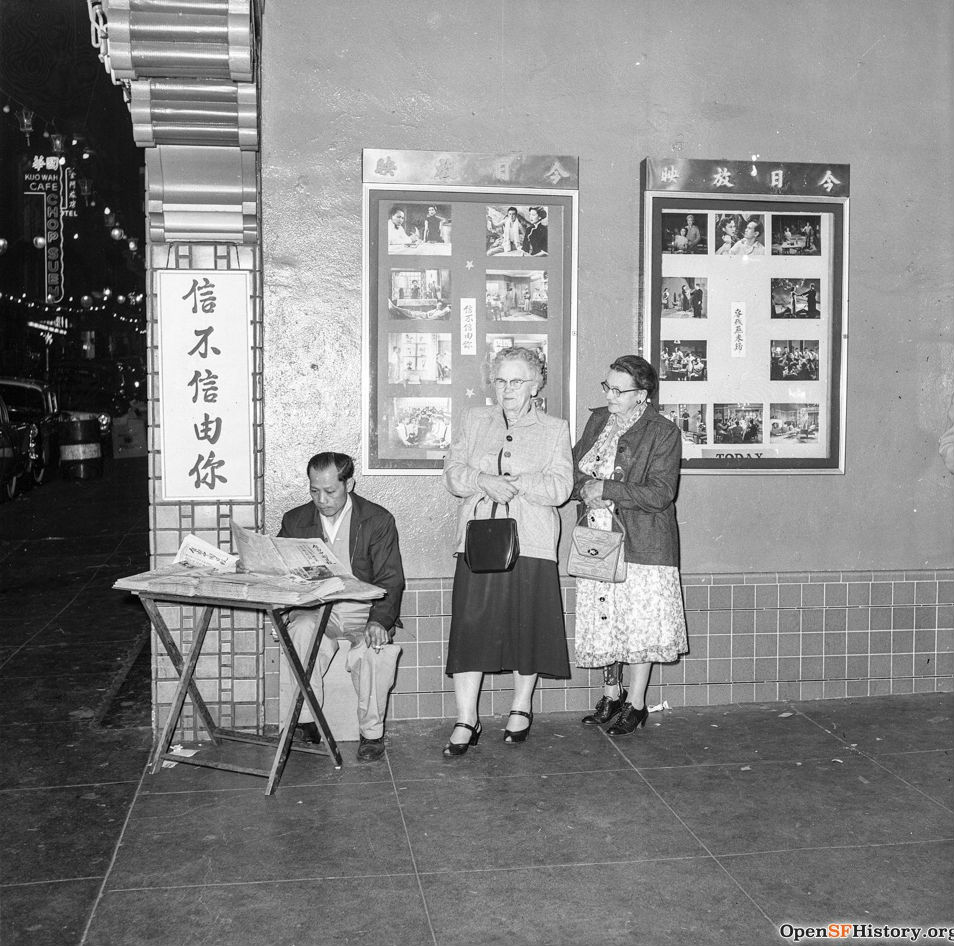
An
August 1944 view in the San Francisco Public Library collection. The
entrance is on the right where the gentleman is standing. Note the
framed photos hanging high on the wall. Originally published in a
newspaper with the caption:
"ALWAYS NEW - It's never quite the same two
days in a row - Chinatown's Grant Ave. Window shopping, poking around in
the Chinese stores, eating Chinese or American dishes in colorful cafes
and an occasional visit to the Mandarin Theater (the entrance is at the
right of this photo), will kill hours - several days, if you wish - on a
stay-at-home vacation."
A
1947 look at the theatre, here still called the Mandarin. It's a San Francisco Public Library
photo. They note it was published with this news copy:
"Strolling down
Grant-av (above) a late-model car contrasts strangely with the Chinese
architecture of a theater behind it." And written on the back was:
"Ayers, Sydney (standing in foreground)."
A
screenshot from Orson Welles' "The Lady From Shanghai" (1948) looking
toward the theatre. It's from a Reel SF page about the film's locations. Also see Brian Darr's 2023 SF Gate article "The San Francisco locations that made this film a 'masterpiece of mood.'"
A detail that Art extracted from the c.1949 photo above. On the right we get a better look at the building that decades earlier had housed the Oriental Theatre, 1035-37 Grant Ave.
A c.1953 view. Thanks to Ria Brodell for spotting this one on eBay. He
included it as a comment to his post about the theatre on the BAHT Facebook page.
Art Siegel notes that the empty space beyond the Sun Sing's building
had been the site of the building housing the Oriental, which had extended
to the corner of Grant and Pacific. A new two-story concrete building
went up on that site in 1953. He adds that the license plate on that car
dates from 1950.
A c.1955 photo from the
Open SF History Project. Thanks to Lily Castello for spotting it for a post on the
BAHT Facebook page.
The theatre in 1956. Thanks to Jack Tillmany for spotting the photo on the Open San Francisco History Project site. It's from the David Gallagher collection. There's also a version with somewhat different color balance on the SF Memory site.
Thanks to Bob Emerson for this fine photo. The commentary he has along with it:
"Built as the Mandarin Theatre in 1925, in the heart of San Francisco’s
Chinatown, it was renamed the Sun Sing Theatre in 1949. Originally,
staged operas at night, but began showing movies during the day. As
operas were presented less frequently, the theaters eventually added movies at night as well. The theaters were an important aspect of life in Chinatown, especially
for first-generation Chinese-Americans. Very few people ventured outside
Chinatown. On a typical weekend night, audiences would line up to see
the latest films from Hong Kong and China at the Sun Sing or at the
Great China.
"Admission was a dime, which included a newsreel and
cartoons in English, and a main attraction in Cantonese. Moviegoers
smoked, and munched on popcorn, melon seeds, and other snacks during the
shows. It closed as a movie house in 1986, and thereafter
converted into retail use, as the Sun Sing Center. Its exterior and
interior were used for a sequence in the 1948 Orson Welles film 'The
Lady From Shanghai.' The Sun Sing Center (1019-1029 Grant
Avenue) consists of two interconnected buildings built in 1924. The
building fronting Grant Avenue is 3 stories with a ground floor retail
and two upper levels of residential units."
Bob's post of the photo was on the Facebook page San Francisco Remembered.
This
1963 photo appears with "The Standing Dead," Sam Hartnett's 2011 Bold
Italic article about San Francisco's abandoned movie theatres.
An undated view that appeared on a Chinatown Facebook page post about theatres in the
neighborhood. Thanks to Kerwin Berk for sharing those seven images on a
post on the Bay Area Historic Theatres page.
An entrance view dated July 1971 in the collection of Jeff Grubbs. In his post on San Francisco Remembered he commented that it was in a box of slides he purchased at a thrift store in Tucson. Thanks to Art Siegel for spotting the post. Jeff's a photographer and can be reached at baddonkeystuff.com.