46 Ellis St. |
map |
Opening: September 2, 1911 as the Cort Theatre with John Cort as proprietor. This pre-opening view looking toward Market is in the collection of the California State Library. A version from the Jack Tillmany collection appears on the Open SF History Project website dated August 1911.
Plans for this site on the north side of the street between Powell and Stockton had been announced in 1909 when it was intended to be a vaudeville theatre for the William Morris circuit called the American Music Hall. Before the 1906 earthquake and fire the site had been home to the
five-story furniture and carpet store of Joseph Fredericks & Co.
The address listed in the city directories flops all over the place. In the early editions it's usually just listed as Ellis between Stockton and Powell, sometimes including the mention that it was on the north side of the street. In 1925 and 1926 (as the Capitol) it's listed as 64 Ellis St. In 1928 and 1930 they give it a 46 Ellis address. In 1938 and 1940 it's listed as at 50 Ellis St.
The 1913 Sanborn map (as spotted by Art Siegel) in the
Library of Congress collection shows the floor plan of the theatre. Ellis Street is on the right. Note the
Orpheum Theatre on O'Farrell Street to the left.
Architect: O'Brien and Werner did a design for the site in 1909 that wasn't used. The new design was by New York-based Henry Ives Cobb, with Henry H. Hedger as the local associate architect (per SF Chronicle, August 27, 1911). Rex Stovel was the decorator.
Seating: It was around 1,700. The main floor sat 692 plus perhaps 24 in the six lower level boxes. The 1st balcony sat 492 plus perhaps 26 in the thirteen boxes along the rail and something like 24 in the six balcony level proscenium boxes. The 2nd balcony appears to be about the same size as the 1st.
A main floor seating chart from the 1915 San Francisco Blue Book. Thanks to Glenn Koch for sharing the image from a copy of the book in his collection. Note who the manager was at the time.
The 1st balcony seating chart from the 1915 San Francisco Blue Book. The book didn't include a chart for the 2nd balcony, also known as the gallery. Thanks, Glenn!
The project begins as the American Music Hall: The site had been acquired on behalf of William Morris in late 1909, as spotted in the November 13, 1909 issue of Variety by Art Siegel, and construction was supposed to begin immediately. It was a project of William Morris Western, a branch of the company's east coast vaudeville circuit. They were having trouble competing with Orpheum for the top stars of the kind Orpheum featured in their two-a-day houses:
"MORRIS CLOSES FOR FRISCO SITE TOUCHING ORPHEUM - Takes Thirty-Year Lease Upon Property Adjoining Western Circuit's Coast Stand. Has St. Louis Coliseum Also. San Francisco, Nov. 11. Walter Huff Seely, the representative of William Morris Western Inc., this week closed a deal whereby that concern takes over for a term of thirty years the parcel of land on the north side of Ellis Street, just off Market Street, from the United Railroads Co., and building operations will be commenced immediately on a theatre costing $250,000.
"The plot measures 97 x 137 feet and the completed theatre will have a seating capacity of 2,100. There is a touch of humor in the fact that the projected theatre, which the Orpheum people have made every effort to block, almost touches the back of the present Orpheum Circuit's house, the Morris stage being backed up against the other theatre's wall.
"The new building, which will be modeled upon the plans of the Empire, London, in all its details, will be ready for opening June 1 next. There is a clause in the Morris-United Railroads Co. under which the lessee may purchase the property at his option at any time within five years."
A December 18, 1909 story about the Music Hall in the San Francisco Dramatic Review. Thanks to Jack Tillmany for sharing the item from his collection. At this time the architects were to be the firm of O'Brien and Werner. Their design was also published in the Architect and Engineer of California for December, 1909.
A closer view of the original design.
Seely and Morris hurtled forward with the theater project, enlisting Morris' friend and client Harry Lauder, the Scottish singer and comedian, to come to San Francisco for a gala cornerstone-laying on January 12, 1910, as reported and pictured by the SF Call, spotted by Art Siegel. Lauder, Morris, Seely and even Morris' son Willy had all received honorary union memberships for the day so they could apply cement to the cornerstone.

In January 1910 William Morris ran large ads promising a September 1910 opening. This was spotted in the Chronicle's January 30 issue by Art Siegel.
However, in March 1910 (as reported by the SF Call, as seen by Art Siegel), Seely was back in town promising to start work and explaining the delay and the retention of a new architect:
"WORK ON AMERICAN MUSIC HALL BEGINS - New Vaudeville House to Be Completed Within 175 Days - Walter Hoff Seely, president of the William Morris Western vaudeville company, returned to San Francisco Saturday morning with plans and specifications for the American music hall which is to be erected in Ellis street near Market. 'My trip to New York,' he said yesterday, "was necessitated by the fact that O'Brien & Werner, who were preparing the plans for the building, threw up the work and left us in a quandary. I went to New York at once and secured the services of Henry Ives Cobb, one of the most noted architects in the world. The Liberty Nassau tower, as it is called, which is one of the tallest and handsomest structures in New York is being built by Cobb, who also designed the congressional library building in Washington, reconstructed the White House and has done other notable work in architecture.'
"Seely held a receipt for the first payment to Cobb for his services—several thousand dollars — and a contract with Long & Hoyt, contractors in this city, whereby they begin work today and agree, under a monetary penalty, to complete the building in 175 working days."
Morris unloads the project: During 1911, William Morris' highly ambitious plans to challenge the "Vaudeville Trust" came to grief and his backers began looking for a way to unload the still-uncompleted theatre. John Cort had been running his
Savoy Theatre on McAllister St. since December 1909 but he wanted a bigger and more opulent house for his shows.
On February 17, 1911 the Chronicle reported that William Hoff Seely had been trying for four months to dispose of the theatre, and was only able to because San Francisco's bid to house the 1915 Panama-Pacific Exposition had been approved. It was reported that a lease to Cort was imminent. It became official on March 1, 1911, when the name was changed from "American Music Hall" to "Cort Theatre." (Chronicle, March 2, 1911, as seen by Art Siegel).
Lurking in the background of this c.1911 photo seen by Art Siegel on SFMemory.org (Randolph Brandt Collection / Courtesy of Emiliano Echeverria), looking east down Ellis St. and just above the streetcar is scaffolding that is likely from the Cort's construction.
Detail from SF Memory photo, supplied by Art Siegel.
Owner John Cort arrived in San Francisco to oversee the final phases of construction. The SF Call printed this image of him in its
August 27, 1911 edition with an interview about his career and the new theatre. This was located by Art Siegel. The theatre finally opened on September 2, 1911.
A view from the stage. Thanks to John Bosko for sharing this photo from his collection on the
Bay Area Historic Theatres Facebook page. Originally unidentified, it was determined to be the Cort when compared with the theatre's seating charts. John notes:
"It was taken by R.J. Waters, a noted San Francisco architectural
photographer. Many of the images I have were taken soon after the 1906
earthquake and into the 19 teens. It has upwards of 1,300 seats on
three levels, and dancing maidens on the circular ceiling....
For
what it's worth the Orpheum and the Cort theaters are the two that I
have exterior shots of in the collection. c.1910-1915."
Two interior views from the Examiner's September 1, 1911 edition, as spotted by Art Siegel. At top, the house right boxes, at bottom an elevated view toward the stage, showing the proscenium mural and a portion of the adjacent ceiling.
A look at the house left boxes and a bit of the proscenium from
The Call's September 1, 1911 edition, as spotted by Art Siegel on the California Digital Newspaper Collection website.
Two 1911 proscenium mural views. At the top, as it appeared in the September 1 issue of The Call. The bottom image is from the Chronicle for August 27. These were found by Art Siegel.
Press coverage frequently mentioned the twelve scantily clad ladies on the round ceiling dome mural, representing the various months of the California year. The August 27, 1911 Chronicle (as seen by Art Siegel) reproduced part of that decoration.
The Call's reporter, Walter Anthony, described the theatre, as well as its pre-opening history:
"The Cort is a beautiful theater. It is also a large theater. A certain lack of the suggestion of intimacy, which in the modern theater. is usually sought for, is in the case of the Cort compensated by the work of the artist who has designed the interior and who has made the last seat in the gallery an integral part, of his artistic scheme. Though the building is large and was designed originally for the sensational of vaudeville, it has been transformed into a cozy playhouse by the decorative skill that has been displayed from gallery to orchestra.
"The stage seems to have been framed. The proscenium arch is the center toward which the eye is cajoled by a cleverly devised color scheme in which the garish has no place. Above the stage is an allegorical subject reminding the beholder of Hamlet's holding the mirror up to nature. The hope is inspired therein that this mirror will never cast distorted reflections on nature. High above and outlining the dome is another allegorical subject. It is a picture of the 12 months of the year, personified by the undraped female figure, and on each the sun is beaming, typifying the constancy of summer in California. Here, as elsewhere throughout the playhouse, is exhibited the gold of this golden state, though there is not apparent anywhere ostentatious display.
"The boxes contain the suggestion of Moorish architecture, although the influence of Spanish renaissance is visible throughout the whole interior decorative scheme. The boxes are ornate but tasteful, and the fronts are garlanded with the flowers of California, notably, of course, the eschscholtzia [California Poppy], whose golden hues blend with the prevailing tones of the theater -- gold and brown. There are 1,845 seats in the house, which is about 1,845 fewer than there should be on the opening night. Of these 1,845 seats, 696 are on the orchestra floor, 492 in the balcony, 509 in the gallery, 96 in the proscenium boxes and 52 in the loges. These latter are similar to balcony seats in the Orpheum. The balcony is fronted by these boxes.
"About $1,000,000 is represented in the investment and investiture of the Cort theater. Originally designed by Walter Hoff Seely as the far western wing of William Morris' insurgent vaudeville, it was turned over by the investors after the collapse of the Morris bubble to John Cort, the legitimate insurgent. Cort leases the property from the Madison Realty company, which was organized by the original investors who had hoped to make an American music hall in San Francisco. However, the spirit of insurgency has not been deadened, and, as the Cort theater the property will be devoted to playing 'independent' attractions, the first of which is Brady's production of the comedy 'Baby Mine.'
"Henry Ives Cobb of New York was secured by Walter Hoff Seely to draw up the plans of his proposed American music hall. The original plans have not since been departed from, only to that degree which seemed proper in converting the theater from vaudeville to the legitimate. Rex Stovel is responsible for the decorations and has done a monumental work. He has disclosed freedom, originality and a positive genius for color. His work on the Cort theater has established him. Homer F. Curran, a graduate from Stanford, and a theatrical man in whom Cort has high confidence, will be the resident: manager. Cort expects to spend most of his time here. Barnet Franklin is in charge of the publicity department of the playhouse, and the box office is in the custody of Charles Newman."
Decorator Rex Stovel, pictured in The Chronicle's August 27, 1911 coverage.
The Chronicle's coverage of August 27, 1911 contained this description of Stovel's interior decoration, as seen by Art Siegel. Stovel had worked with Seely on the
Valencia Theatre.
"The Cort, San Francisco's Latest Imposing Theatre." This drawing, representing Henry Ives Cobb's redesign of the new playhouse, appeared as part of "
San Francisco's Theatrical Rehabilitation," an article on page 50 of the August 1912 issue of The Theatre Magazine. It's on Google Books.
Gertrude Hoffman arrived for 2 weeks of Russian ballet on October 30, 1911. Art Siegel spotted this on eBay.


Art Siegel spotted these excerpts from a program for a March 1915 production of "Everywoman" on eBay.
The cover of the program for an August 10, 1915 Bohemian Grove concert. An inside page titled it "Concert of the Midsummer Music of Bohemia, performed by an orchestra and members of the club." See the club's
Bohemian Grove Museum pages for what materials they have online.
A c.1915 program cover located on eBay by Art Siegel. The seller did include some inside pages of ads from the program in the sale listing, but nothing to indicate what show was playing. The bottom of the sculpture says "San Francisco." The text below that says "Green's Adv. Agency."
This February 1916 ad for "The Only Girl" was located by Ken McIntyre for an extensive post about the theatre for
Ken's Movie Page on Facebook. Eighteen other items he located also appear here on this page.
"Not Playing Oakland." It's a May 1916 ad Ken found for "The Passing Show."
Peter M. Field, author of
"The Tenderloin District of San Francisco Through Time,"
notes that Rector's, a Tenderloin café of dubious distinction, was in
one of the theatre's storefronts in 1916 and was frequently listed as a
site of police raids and on lists of places the reformers wanted to shut
down. A Chronicle ad in 1916 listed the address as 36 Ellis and noted
that it was under the Cort Theatre.
An October 1916 ad for the "Cyclonic" Eva Tanguay that was located by Ken McIntyre.
The La Scala Grand Opera Company arrived for a two week season featuring Maggie Teyte, Ester Ferrabini and Nina Morgana in October, 1917. Art Siegel spotted this handbill on eBay.
The September 14, 1918 SF Chronicle announced that the Cort was to be renamed the Curran Theatre on September 22. Homer Curran was the operator. According to the announcement, spotted by Art Siegel, Curran took over Cort's local interests, as Cort wanted to increase his presence as a producer in New York.
The San Francisco Symphony onstage at the theatre in 1919. They had given their first performance at the Cort on December 8, 1911 and continued performing at the theatre after it was renamed the Curran. The Symphony later moved over to the
Tivoli Theatre on Eddy St.
"Hello, Alexander," a minstrel show featuring James McIntyre and Thomas K. Heath. Thanks to Mark Reed for locating this ad in the October 17, 1920 issue of the Chronicle.
Messrs. McIntyre and Heath in a 1910 photo located by Mark Reed. He notes that the duo performed together for over 50 years in theatres in San Francisco and elsewhere.
An October 1920 ad for a musical called "Buddies" and then a film booking: Griffith's "Way Down East." Thanks to Ken McIntyre for sharing the ad.
Thanks
to Jack Tillmany for finding this image of the program cover for the
February 1921 appearance of Anna Pavlova at the theatre. Homer Curran's
name appeared on a theatre again when he built the present
Curran Theatre on Geary St. in 1922.
The theatre was renamed Century in September 1921. Thanks to Mike
Rivest for locating this September 3, 1921 ad for the Fox film "The Queen
of Sheba." It was mistakenly posted on the Cinema Treasures page for the OTHER Curran Theatre, the present one on Geary St.
It reopened as the Morosco on September 3, 1922 with Oliver Morosco's production of the musical comedy "You'll Be Surprised."
Louis Lurie was the next lessee and he changed the
name to the Capitol.
The Billboard issue of October 6, 1923 had this September 30 report that recounted the transfer of the operation from Louis Lurie to the Herbert L. Rothchild chain. Thanks to Art Siegel for locating it. Rothchild already had the
Granada,
California,
Portola and
Imperial. The article recounted the four prior groups of management/ownership since John Cort.
A December 20, 1924 story about "White Collars" at the Capitol. This item and the ad below were spotted by Ken McIntyre. Frank Egan, producer of the show, had quite a career in Los Angeles, operating a drama school with Oliver Morosco and then running a theatre on Figueroa St. that was later called the
Musart.
A December 20, 1924 ad for "White Collars."
W.P. Cullen is listed as the manager in the 1925, 1926 and 1928 city directories. Peter Field notes that in 1926 there were several reports that the theatre was to be razed and a hotel-apartment building erected in its place but the deals didn't happen.
A September 1926 ad Ken located for Will Morrissey's "Music Hall Revue. And then another film booking, Valentino in "The Son of the Sheik."


"One Man's Woman", which the Chronicle's review called a tropical melodrama, played at the Capitol in June 1927. Playbill from eBay, spotted by Art Siegel.
A July 14, 1928 opening day ad for the theatre, renamed the New Capitol.
This July 14, 1928 Bulletin story announced the change of name and Jack Brehany as "lessee-pilot." It promised a completely rejuvenated theatre. The $55,000 remodel included a 35-foot vertical sign with the new name, as well as $10,000 in new seats. The redecoration also included Italian Renaissance-inspired murals on both the auditorium ceiling and the inner foyer.
A new floor was installed, the stage rebuilt and deepened, and all the stage equipment replaced. The old projection booth was removed and inner foyer deepened. A seating capacity of "more than 1,500" was described, as well as a new box office with two windows. Spotted by Art Siegel.
Unfortunately, "The Captive" was shut down on opening night when police took the stage during the third act and arrested the manager and cast for giving a performance "offensive to common decency." The Examiner ran photos two days later, on the 16th. Spotted by Art Siegel.
The cover of a February/March 1930 program on
Calisphere from the Museum of Performance and Design Performing Arts Library.
In June 1930, after a closure, the Capitol got a burlesque show. "Burlesque Shows to Reopen Capitol" was the headline of a June 30 article on page 8 of the Examiner that was located by Nathan Swanson. He notes that the story "details the transformation of the theatre into a burlesque house with a resident burlesque girl chorus of 60 girls. The change was made by theatrical producer Warren Irons. There are reviews and advertisements for burlesque shows from that point on until the theatre closed in 1941."
For much of the 1930s, when it didn't have stage shows, the Capitol was a 15 cent grind film house. Peter M. Field notes that in 1931 the assistant manager was one Eddie Skolak. He had come from Chicago and was living at the Hotel Butler at O'Farrell and Mason. Skolak had moved up to being listed as treasurer in the 1933 and 1934 city directories. Field says: "He was absent from the city directories in 1935 and 1936. Bet there’s a story there."
In its April 20, 1935 issue, Billboard reported that the theatre, which had been dark for a year, had reopened on April 12th. The latest management team was Robert Helms and Wally Feeham. Spotted by Art Siegel.
Burlesque is back in 1935: "Capitol Starting Another Season of New Burlesque," an article located by Nathan Swanson on page 19 of the July 26, 1935 issue of the Examiner stated that the Capitol
had been San Francisco's main burlesque theatre for the past five years. It was typically a stage show + film format. Usually there were three shows a day with films in between. Friday and Saturday nights got an added stage show at midnight.
A September 1935 article spotted by Ken McIntyre.
An April 1936 article spotted by Ken about "New Effects."
"76 People." It a June 1936 ad located by Ken McIntyre.
In 1937 Eddie Skolak returned to the Capitol, this time as the proprietor. He continued offering burlesque shows and rebranded the house as the Capitol Follies.
"CHORUS girls wanted." It's a June 1938 ad located by Ken McIntyre.
A July 1938 Follies program from the Jack Tillmany collection.
A portion of the inside of the 1938 Follies program.
A 1940 advertising card for the Follies. It's from the Jack Tillmany collection.

This ad appeared in the February 18, 1940 Chronicle and was spotted by Art Siegel.
A June 1940 ad for Renee and the Blonde Venus that Ken McIntyre located.
A May 9, 1941 article about the new show that week.
The death knell for the theatre sounded in May 1941 with reports about the sale of the building. Thanks to Ken McIntyre for spotting this article.
"Twenty-one sequences of stage entertainment" plus "Sex Mania" on the screen. It's a May 21, 1941 item Ken located about the show that week.

More details emerged in this May 24, 1941 SF Examiner report. The widow and heirs of Comstock Lode silver magnate James L. Flood had traded a huge amount of his extensive property in San Mateo County for the theatre. The article noted that the adjacent
Orpheum Theatre on O'Farrell St. had already met the same fate. Art Siegel located the story.
Another May 1941 article about the property going to the Flood estate. Ken McIntyre located it.
The ad for the final show that ran in the Examiner on June 21, 1941, noting "building to be wrecked after Sunday night." The ad was spotted by Art Siegel.
The San Luis Obispo Telegram-Tribune ran this obit for the theatre on June 23, 1941, describing its final feature "Everything Goes." By then it seems its days as the gem of John Cort's theatrical empire had been forgotten. Rex Stovel's elegant scantily-clad maidens on the ceiling (if they survived the many renovations) might have stared across time at "Gertie, Gene, Ruby, Lucille and Agnes." This was spotted by Art Siegel.
On June 22, 1941, the Examiner ran this classified ad from the wreckers, announcing sale of seats, props and stage equipment on the following day. In mid-October, they were advertising 300 seats still available at $1 each. It's an item located by Art Siegel
Closing: June 22, 1941 was the last day of operation.
A July 1, 1941 story about the shows moving to the
Liberty Theatre at 649 Broadway, rebranded by Eddie Skolak as the Liberty Follies. Thanks to Ken McIntyre for locating this.
Status: The theatre was demolished in 1941.
This July 1941 story noted that the demolition was then underway. It's another item spotted by Ken McIntyre for his post about the theatre for
Ken's Movie Page on Facebook.
The theatre's site is now the south end of the Ellis-O'Farrell Parking Garage. The
Orpheum was where the north end of the garage now is.
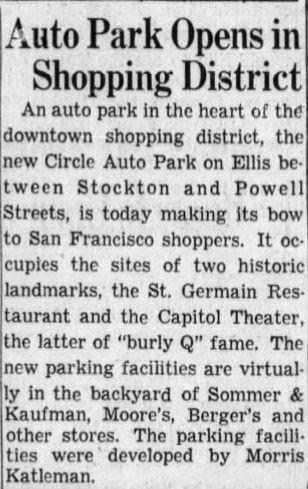
On November 1, 1941, the Examiner announced that the parking lot on the site of the Capitol and the adjoining St. Germain Restaurant was open for business. Spotted by Art Siegel.
Later Skolak moved his shows to the
President Theatre on McAllister St. Peter M. Field comments:
"At the time,
burlesque at the Capitol must have made economic sense, located as it
was in a largely single male neighborhood, to say nothing of all the
servicemen coming to the Tenderloin from all the military bases around
the Bay Area. As a Tenderloin resident, Skolak was a little unusual.
"He
held steady jobs, and he lived in the same place—the Hotel Crossen on
Ellis between Powell and Mason—for a number of years. With his name,
occupation, and Chicago antecedents, he might have been a real
character, but a relatively dependable one. After all, he eventually
bought the President Theatre and kept it going to 1963. And he left a
substantial estate from its sale to his wife. Not so bad."
More exterior views:
An early postcard view of the Cort. Many thanks to Glenn Koch for sharing the card from his collection.
A 1911 look at the new theatre. Thanks to John Bosko for posting the photo from his collection on the
BAHT Facebook page.
A detail from the same image that's in John Bosko's collection. This one, from Jack Tillmany, appeared on the Facebook page
Lost San Francisco where they give a nice history of the San Francisco Symphony's wanderings around many different downtown theatres over the years. A smaller version of the photo is on the
San Francisco Public Library website.
The San Carlo Grand Opera was on the sign in this February 1920 photo from the
San Francisco Public Library website. A copy from the Jack Tillmany collection appears on the
Cinema Tour page about the theatre.
The four eagles and ten Corinthian column and pilaster capitals. This and the two images below are details that Art Siegel grabbed from the 1920 photo above that's on the SFPL website.
The swingout sign.
The programmable sign on the corner of the marquee.
A November 1922 photo of the theatre as the Century from the Emiliano Echeverria / Randolph Brandt Collection. The event was the premiere of "Hunting Big Game in Africa With Gun and Camera" by Oakland hunter/explorer H.A. Snow (1869-1927). The photo is on the
Open SF History Project website. There's also a version in the
San Francisco Public Library collection from Jack Tillmany where they give it an October 24, 1921 date.
Another November 1922 "Hunting Big Game" photo from the Emiliano Echeverria / Randolph Brandt Collection. Thanks to Peter Field for spotting this one on the
Open SF History Project website.
We're looking up from the corner of Market and Ellis in 1926 after the theatre got renamed the Capitol. It's a photo on
Calisphere from the Museum of Performance and Design Performing Arts Library. There's also a version from Jack Tillmany on the
San Francisco Public Library website. It is a detail from a photo on the
Open SF History site, where it is dated October 29.
A 1928 photo from the San Francisco Public Library collection. Art Siegel notes that although a version of this shot appeared in the July 14 San Francisco Bulletin to illustrate that night's reopening as the "New Capitol," the Library gives it a July 16 date on their website.
"Now Playing 15 cents Anytime" "3 Big Hits." It's a May 13, 1935 view of the theatre as a grind house. A group of firemen raise a tall ladder. The handwritten caption is "Capitol Theater Fire." It appears on the
Open SF History archive. The photo from the Jack Tillmany collection also appears on a
Cinema Tour page.
Looking west toward Powell c.1956. The Morton-Waters Co. photo was to be cut up for art students' collage projects when it was rescued by David Gallagher for inclusion in the
Open SF History Project. They note that the garage was almost finished with a sign advertising an August 1 opening. Between the 1941 demolition and this construction, the theater site was a street level parking lot. The garage has since been increased by 2 more stories.
On Ellis looking toward Powell St. in 2016. The garage on the right sits on the site of the theatre. Photo: Google Maps
More information: Thanks to Peter M. Field for his research on the Cort. For a fine history of the neighborhood see his 2018 Arcadia Publishing book "The Tenderloin District of San Francisco Through Time." It's available through Amazon.
See the
Cinema Tour page about the theatre, which they list as the Capitol.
Cinema Treasures also has a page on the theatre.
Jack Tillmany's Arcadia Publishing book "Theatres of San Francisco" can be previewed on
Google Books. It's available from
Amazon or your local bookseller.


.jpg)




.jpg)


The theatre's later history could use some updats. Burlesque history starts much earlier if you go into newspaper archives. See "Burlesque Shows to Reopen Capitol". The San Francisco Examiner. June 30, 1930. p. 8. which details the transformation of the theatre into a Burlesque house with a resident burlesque girl chorus of 60 girls. The change was made by theatrical producer Warren Irons. There are reviews and advertisements for burlesque shows from that point on until the theatre closed in 1941.
ReplyDeleteIt's true that cinema also played at the theatre in 1930s, but films were a part of the rotating repertoire at the theatre in the 1910s and 1920s as well. In the 1930s films were often were shown as part of the Burlesque show. See "Capitol Starting Another Season of New Burlesque". The San Francisco Examiner. July 26, 1935. p. 19. which states that the Capitol had been San Francisco's main burlesque theatre for the past five years. See "Late Show Slated At Capitol Theatre Tonight". The San Francisco Examiner. December 3, 1938. p. 18. for an example of a film shown alongside strip tease acts, dancing and singing numbers, etc. If you search newspapers.com you will see burlesque was the main focus of the theatre from June 1930 until closing in 1941. -Nathan Swanson
Thanks for the research!
Delete